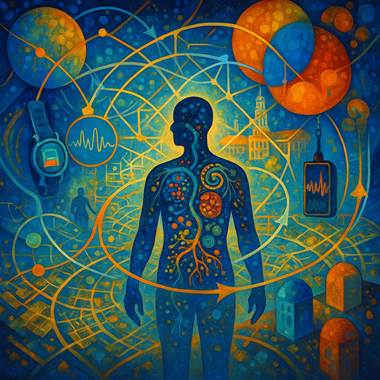
Roger F Malina, Fred the Heretic and Aperio
May 12 2025
and social and biological and
**Abstract:**
This article introduces exposomics—the comprehensive, high-resolution analysis of all environmental and lifestyle exposures across the lifespan—and frames its methods and insights within the Off Center for Emergence Studies (OC4ES) agenda. After defining the exposome’s external (chemical, physical, social) and internal (biochemical, microbiome, epigenetic) dimensions, we review cutting-edge tools—wearable sensors, high-resolution mass spectrometry, geospatial mapping, and machine-learning integration—that enable systematic tracing of exposure–response patterns. We then draw parallels between exposomics’ probe–sense–respond workflows and OC4ES’s transdisciplinary practices, highlighting opportunities to smash academic silos through joint mapping of exposures and departmental networks. Concrete collaborations are proposed—integrating UTD’s silo database with campus exposome maps, deploying sensor-augmented ArtSciLab installations, embedding exposome case studies into emergence seminars, and prototyping adaptive environmental controls. Finally, we outline a vision for “Exposé of Exposomics” at OC4ES: immersive art-science exhibits, community co-design workshops, and policy dialogues that reveal hidden environmental influences. By weaving exposomics into OC4ES’s networked, multiscale approach, we argue that emergent patterns of health, behavior, and community become visible only through truly cross-disciplinary engagement. We conclude with an exposer by Fred the Heretic
— Aperio
**Table of Contents**
2. **Definition of Exposomics**
3. **What Is Exposomics?**
3.1. Exposome: Origins and Scope
3.2. Exposomics: Measurement and Analysis
4. **Core Components of Exposomics**
4.1. External Exposome
4.1.1. Chemical Exposures
4.1.2. Physical Exposures
4.1.3. Social Exposures
4.2. Internal Exposome
4.2.1. Biochemical Markers
4.2.2. Microbiome Communities
4.2.3. Epigenetic Modifications
5. **Methods & Technologies**
5.1. Wearable & Ambient Sensors
5.2. High-Resolution Mass Spectrometry
5.3. Geospatial & Network Mapping
5.4. Data Integration & Machine Learning
6. **Why Exposomics Matters for Emergence Studies**
6.1. Multiscale Networked Thinking
6.2. Probe–Sense–Respond Workflows
6.3. Smashing Disciplinary Silos
7. **Connecting Exposomics to OC4ES’s Work**
7.1. Silo Mapping
7.2. Transdisciplinary Probes
7.3. Emergence Seminars
7.4. Iterative Feedback
8. **Toward an “Exposé of Exposomics” at OC4ES**
8.1. Art-Science Exhibits
8.2. Community Engagement
8.3. Policy Dialogue
9. **Glossary of Key Terms**
10. **Annotated Bibliography**
11. **Conclusion: The Science of Team Science & Next Steps**
12. **Verses on the Exposome**
13. **References**
Definition
is the systematic study of the “exposome”—the totality of an individual’s environmental and lifestyle exposures (chemical, physical, social, and biological) from conception onward—and how these cumulative exposures influence all phenomena.
1. What Is Exposomics?
- Exposome: Coined by Christopher Wild in 2005, the exposome encompasses every non-genetic exposure—from air pollution and diet, to social stressors and the built environment—that interacts with our biology over time.
- Exposomics: The systematic, high-resolution measurement and analysis of the exposome, using tools like wearable sensors, high-throughput bioanalysis, geospatial mapping, and data science, to link exposures with health outcomes.
2. Core Components of Exposomics
- External Exposome
- Chemical: Pollutants, chemicals in consumer products, food additives
- Physical: Noise, temperature extremes, radiation
- Social: Socioeconomic status, stress, community networks
- Internal Exposome
- Biochemical: Metabolites, hormones, inflammation markers
- Microbiome: Gut and skin microbial communities
- Epigenetic: DNA methylation and other modifications induced by exposures
3. Methods & Technologies
- Wearable & Ambient Sensors: Personal monitors for air quality, UV, noise, physiological parameters.
- High-Resolution Mass Spectrometry: Detects thousands of small molecules (“chemical fingerprints”) in blood or urine.
- Geospatial & Network Mapping: GIS tools map environmental exposures across places and times.
- Data Integration & Machine Learning: Synthesizes multidomain data streams to uncover exposure–response patterns.
4. Why Exposomics Matters for Emergence Studies
Emergence studies ask how complex patterns arise from interacting parts. Exposomics similarly looks at how myriad, dynamic exposures interact to shape health and behavior in unpredictable ways. Both fields:
- Embrace multiscale, networked thinking—from molecular to societal levels.
- Use “probe–sense–respond” workflows: deploy sensors (probes), collect data (sense), adapt models or interventions (respond).
- Seek to smash silos: chemical toxicology, epidemiology, sociology, data science, even design and the arts.
5. Connecting Exposomics to OC4ES’s Work
| OC4ES Pillar | Exposomics Parallel | Possible Collaborative Activities |
| Silo Mapping | Mapping exposures across environments and social networks | Integrate UTD’s silo database with geospatial exposome maps to visualize “exposure silos.” Under way under the lead of Robert Stern and Anna Xie |
| Transdisciplinary Probes | Deploy small-scale exposome sensing experiments in diverse contexts | ArtSciLab installations: wearable pollutant badges in galleries; sensor-augmented “biophilic” work pods. |
| Emergence Seminars | Case studies of emergent health patterns from exposome data | Student projects decoding how campus microenvironments (labs, libraries) modulate stress biomarkers. Under way with the Healing Canvass less by Shreyas Chandra |
| Iterative Feedback | Rapid cycle of data collection, modeling, and design interventions | Prototype adaptive HVAC/art-lighting systems that respond to real-time indoor air quality and occupant well-being metrics. |
6. Toward an “Exposé of Exposomics” at OC4ES
- Art-Science Exhibits: Visualize chemical “fingerprints” of different lab spaces as evolving light-scapes. Under way in the ArtSciLab ArtScience gallery under the lead of EZE Ozbkayana
- Community Engagement: Workshops where participants co-design low-cost sensors, reflecting on how their own daily exposures shape their sense of place. NO SENSORS PLEASE JUST THINKING
- Policy Dialogue: Bring together environmental scientists, urban planners, artists, and policymakers to explore emergent – and often invisible – environmental threats.
Glossary
- Exposome: The totality of environmental exposures (external and internal) over a lifetime.
- Probe–Sense–Respond: A cyclical method of small experiments (“probes”), data gathering (“sense”), and adaptive change (“respond”).
- Geospatial Mapping: Plotting data onto maps to reveal spatial patterns of exposure.Under way.
- High-Resolution Mass Spectrometry: Analytical technique to profile thousands of molecular species in biological samples.
By weaving exposomics into OC4ES’s transdisciplinary framework, we can illuminate the hidden networks of environmental influence—revealing emergent patterns of health, behavior, and community that no single discipline can fully capture.
— Aperio
• “Integrating exposomics into biomedicine,” Science, 388(6745):356–358.
https://www.science.org/doi/10.1126/science.adr0544 Science
In Science (Apr 25, 2025), argue that systematically characterizing the full range of environmental and lifestyle exposures—the “exposome”—and integrating it with genomic, proteomic, and metabolomic data will transform biomedicine. They highlight several proof-of-concept successes:
- Identification of an industrial solvent as the driver of kidney disease clusters in factory workers.
- Use of satellite‐derived pollution maps linked to residence data to quantify particulate-driven brain aging.
- Discovery of trimethylamine N-oxide (TMAO), a gut-microbiome metabolite from red meat and dairy, as a previously unrecognized heart-attack risk factor.
These breakthroughs were enabled by cutting-edge tools such as wearable real-time exposure sensors, ultra-sensitive mass spectrometers, and fine-scale geospatial imaging (EurekAlert!).
Miller et al. lay out a clear roadmap for bringing exposomics into routine biomedical practice:
- Technological innovation: Develop minimally invasive or wearable devices capable of measuring personal exposomes across the lifespan.
- Human exposome reference: Assemble population-scale exposome benchmarks to contextualize individual data.
- Standardized protocols and AI: Create harmonized workflows and AI-driven analytics to manage and interpret complex, multidimensional exposure datasets.
- Ethical and social considerations: Address data privacy concerns and ensure that social determinants of health are meaningfully captured.
- Global infrastructure: Leverage newly launched U.S. and European exposomics hubs (e.g., NEXUS, IndiPHARM) to standardize methods, harmonize data sharing, and train a cross-disciplinary workforce.
By embedding exposomics alongside other “omics” disciplines, the authors envision a future in which every major disease study incorporates comprehensive exposure profiling, leading to more precise prevention strategies, targeted therapeutics, and a deeper understanding of health disparities (EurekAlert!).
Here are some of the major “-omics” disciplines beyond exposomics, each focused on a different layer of biological information:
- Genomics
Study of an organism’s complete DNA sequence (its genome), including variation and function of genes. - Epigenomics
Analysis of heritable changes in gene expression not encoded in the DNA sequence itself—e.g., DNA methylation, histone modifications. - Transcriptomics
Profiling of all RNA transcripts (mRNA, non-coding RNA) in a cell or tissue, revealing which genes are actively expressed and at what level. - Proteomics
Comprehensive measurement of the entire set of proteins (the proteome), including their abundance, modifications, and interactions. - Metabolomics
Quantification of small-molecule metabolites (the metabolome) within cells, tissues, or biofluids, reflecting biochemical activity and physiological state. - Lipidomics
Targeted study of the full lipid complement (the lipidome), important for membrane biology, signaling, and energy storage. - Glycomics
Characterization of all glycan (sugar) structures—bound to proteins or lipids—in a biological system, crucial for cell–cell communication. - Microbiomics / Metagenomics
Analysis of the collective genomes of microbial communities (e.g., gut, skin, soil), illuminating how microbiota influence health and environment. - Pharmacogenomics
Intersection of genomics and pharmacology: how genetic variation affects individual responses to drugs. - Toxicogenomics
Integration of genomic and toxicological data to understand how environmental toxins perturb gene expression and pathways. - Nutrigenomics
Study of how nutrients and dietary components interact with the genome to influence health and disease. - Interactomics
Mapping of molecular interactions (protein–protein, protein–DNA/RNA) to decipher complex cellular networks. - Phenomenomics (Phenomics)
High-throughput measurement and analysis of phenotypes (observable traits) across large populations or experimental conditions.
Together, these complementary “omics” layers can be integrated to build a holistic, systems-level understanding of biology, disease mechanisms, and personalized interventions.
— Aperio
There are no reported cases of exposomics being used explicitly to “bridge silos” in universities (e.g., to integrate departmental or disciplinary barriers), but there are closely related precedents in other organizational settings:
- Policy-making organizations. The EU’s EXPOsOMICS project has specifically called out the need to break “institutional silos in policy-making organizations” by uniting chemical, physical and social exposure data into a single risk-assessment framework (BioMed Central).
- Federated data networks. Recent exposomics publications emphasize federating data and changing institutional culture—much like dismantling silos—to enable sharing across laboratories and agencies (Oxford Academic, Oxford Academic).
- Research consortia. The NIH’s NEXUS coordinating center seeks to weave together multiple exposome initiatives and public‐health networks—another model for cross-organizational integration, albeit focused on projects rather than internal university departments (nexus-exposomics.org).
So far, no one has reported applying exposomic methods to break down academic silos within a single university. However, these examples offer blueprints—federated data platforms, cross-stakeholder workshops and policy conferences—that could readily be adapted to foster inter-departmental collaboration on campus.
CONCLUSION
Absolutely— the Science of Team Science (SciTS) is directly relevant to any effort to bridge silos, whether you’re integrating exposomics into medicine or fostering interdisciplinarity on campus. Here’s how:
- Defining Team Science and SciTS
- Team Science is “a collaborative effort to address a scientific challenge that leverages the strengths and expertise of professionals…trained in different fields,” recognizing that complex problems often exceed the scope of a lone investigator (Cancer Control Division).
- The Science of Team Science (SciTS) is the meta-discipline that studies how such cross-disciplinary teams form, function, and succeed, translating emerging insights into best practices and evaluation tools (Cancer Control Division, Wikipedia).
- Key SciTS Insights for Bridging Silos
- Shared Vision and Goals. SciTS research shows that teams with a clearly articulated, co-developed mission overcome discipline-specific agendas more effectively. Establishing a unifying exposomics “north star” can focus diverse units on common health-outcome metrics.
- Boundary-Spanning Roles. Embedding “liaison” or “integrator” roles—individuals charged with translating between genomics, toxicology, epidemiology, and clinical units—mirrors SciTS recommendations for dedicated coordination positions that reduce miscommunication.
- Collaborative Infrastructure. SciTS emphasizes the need for interoperable data platforms, regular cross-team meetings, and shared vocabularies. For exposomics, that might mean standardized exposure ontologies and a centralized dashboard that all departments can access.
- Team Training and Facilitation. Investing in team-science workshops—covering conflict resolution, interdisciplinary communication, and co-design methods—builds the relational “glue” that SciTS identifies as critical for sustaining long-term collaborations.
- Evaluation and Feedback. SciTS offers validated metrics and qualitative tools (surveys, social‐network analysis) to assess team health, integration levels, and outcomes. Regular evaluation cycles ensure that silo-bridging efforts adapt and improve.
- Practical Steps Informed by SciTS
- Host a series of facilitated “exposome hackathons” where chemists, clinicians, data scientists, and social-science researchers co-create pilot studies, applying SciTS-style structured brainstorming (e.g., team charters, shared decision-making protocols).
- Create an “Exposome Integration Toolkit”—drawing on the NCI Team Science Toolkit—that lays out roles, workflows, and communication norms tailored to your institution’s structure.
- Launch a minor “SciTS+Exposomics” working group tasked with developing cross-departmental training modules and evaluating progress against shared outcomes every six months.
By grounding your silo-bridging strategy in SciTS principles—clear mission, boundary-spanning roles, tailored infrastructure, team training, and ongoing evaluation—you’ll accelerate the integration of exposomic approaches across your organization and ensure that collaborations not only form but thrive.
Additional key reference:
Abstract:
This article introduces exposomics—the comprehensive, high-resolution analysis of all environmental and lifestyle exposures across the lifespan—and frames its methods and insights within the Off Center for Emergence Studies (OC4ES) agenda. After defining the exposome’s external (chemical, physical, social) and internal (biochemical, microbiome, epigenetic) dimensions, we review cutting-edge tools—wearable sensors, high-resolution mass spectrometry, geospatial mapping, and machine-learning integration—that enable systematic tracing of exposure–response patterns. We then draw parallels between exposomics’ probe–sense–respond workflows and OC4ES’s transdisciplinary practices, highlighting opportunities to smash academic silos through joint mapping of exposures and departmental networks. Concrete collaborations are proposed—integrating UTD’s silo database with campus exposome maps, deploying sensor-augmented ArtSciLab installations, embedding exposome case studies into emergence seminars, and prototyping adaptive environmental controls. Finally, we outline a vision for “Exposé of Exposomics” at OC4ES: immersive art-science exhibits, community co-design workshops, and policy dialogues that reveal hidden environmental influences. By weaving exposomics into OC4ES’s networked, multiscale approach, we argue that emergent patterns of health, behavior, and community become visible only through truly cross-disciplinary engagement.
— Aperio
Annotated Bibliography
### 1. Wild, C. P. (2005).
**“Complementing the Genome with an ‘Exposome’: The Outstanding Challenge of Environmental Exposure Measurement in Molecular Epidemiology.”**
*Cancer Epidemiology, Biomarkers & Prevention*, 14(8), 1847–1850.
> **Annotation:**
> Christopher Wild introduces the concept of the **exposome**—“the totality of environmental exposures (external and internal) over a lifetime”—urging epidemiologists to pair genomic maps with high‐resolution exposure profiles. He distinguishes the **external exposome** (e.g., pollutants, noise, social stressors) from the **internal exposome** (e.g., metabolites, microbiome shifts, epigenetic marks), setting the terminological foundation that OC4ES adopts when “mapping exposure silos” across campus environments.
### 2. Miller, G. W., et al. (2025).
**“Integrating Exposomics into Biomedicine.”**
*Science*, 388(6745), 356–358.
[https://www.science.org/doi/10.1126/science.adr0544](https://www.science.org/doi/10.1126/science.adr0544)
> **Annotation:**
> This landmark review demonstrates how **high-resolution mass spectrometry** and wearable **probes** (e.g., personal air‐quality sensors) uncover “chemical fingerprints” linked to kidney disease clusters and brain‐aging patterns. The authors outline a **probe–sense–respond** workflow—deploy small experiments (**probes**), collect multidomain data (**sense**), then iterate interventions (**respond**)—a cycle mirrored by OC4ES’s ArtSciLab installations and adaptive environmental controls.
### 3. Rappaport, S. M., & Smith, M. T. (2010).
**“Environment and Disease Risks.”**
*Science*, 330(6003), 460–461.
> **Annotation:**
> Rappaport and Smith argue for an exposure‐centric paradigm that leverages **geospatial mapping** to overlay land‐use, pollution sources, and health outcomes. Their call for federated data platforms and cross‐disciplinary collaboration directly informs OC4ES’s plan to integrate UTD’s silo database with campus‐wide GIS layers—visualizing “exposure silos” as networked phenomena rather than isolated departmental datasets.
### 4. Vermeulen, R., et al. (2020).
**“The Human Exposome: Current State and Future Directions.”**
*Environmental Health Perspectives*, 128(6), 065001.
> **Annotation:**
> Vermeulen and colleagues survey advances in **wearable & ambient sensors** (air, UV, noise) and outline the need for AI-driven **data integration** to synthesize high-dimensional streams. They advocate building a **Human Exposome Reference** database—an OC4ES aspiration for campus benchmarks that contextualize individual and departmental exposure profiles against a broader population‐scale backdrop.
### 5. National Cancer Institute. (2019).
**Team Science Toolkit.**
> **Annotation:**
> While not exposomics-specific, the NCI’s **Team Science Toolkit** codifies best practices—shared visioning, boundary-spanning roles, and evaluation metrics—for sustaining cross-disciplinary teams. OC4ES leverages these SciTS (Science of Team Science) principles to ensure that chemical, physical, and social exposure data are interpreted through a unified, collaborative framework.
## Integrated Glossary & Key References
* **Exposome** (Wild 2005): The totality of environmental exposures (external and internal) over a lifetime.
* **External Exposome** (Wild 2005): Non-genetic exposures outside the body—chemical (pollutants, additives), physical (noise, radiation), social (stress, SES).
* **Internal Exposome** (Wild 2005): Biochemical and biological responses within the body—metabolites, microbiome composition, epigenetic modifications.
* **High‐Resolution Mass Spectrometry** (Miller 2025): Analytical technique profiling thousands of small molecules (“chemical fingerprints”) in biofluids.
* **Probe–Sense–Respond** (Miller 2025): A cyclical workflow of small experiments (**probes**), comprehensive data gathering (**sense**), and adaptive interventions (**respond**).
* **Geospatial Mapping** (Rappaport & Smith 2010): Plotting environmental data onto maps to reveal spatial exposure patterns.
* **Wearable & Ambient Sensors** (Vermeulen 2020): Devices that continuously monitor personal and environmental parameters (air quality, UV, noise).
* **Data Integration & Machine Learning** (Vermeulen 2020): Synthesizing multidomain exposure streams to uncover exposure–response relationships.
* **Science of Team Science (SciTS)** (NCI 2019): Research on how cross-disciplinary teams form, function, and succeed, offering frameworks for shared vision, roles, and evaluation.
**Verses on the Exposome**
**I. The Map Beyond the Gene** and Expose
Not in the twist of the helix alone
Is the story of our days inscribed,
But in the breath that coats the leaf
And the shimmer of soot in a neon sky.
Wild named it first, the hidden sum—
This **exposome**, vast and omnivorous:
The touch of lead in a childhood snack,
The cortisol surge at a parent’s shout.
It lies both **outside** us—in sound, in smoke—
And **within**, in the gut’s uneasy flora,
In whispered tags on methylated strands,
In blood that carries yesterday’s terrain.
**II. The Chemical Fingerprint**
Sensors bloom like morning glory
On wrists, on vents, in lab-lit lungs.
Their whisper: **probes**. Their method: sense.
Their promise: to **respond**, adapt, correct.
Each breath a barcode, each sweat a tale,
Each aging cell a line of code.
Miller traced them with the spectral eye,
In veins and fog and burning oil.
So ArtSciLab lays down its trail:
A living loop, a rhythm of trial—
Probe, sense, respond. Then start again.
Not healing yet, but hearing pain.
**III. The Silos Seen Afar**
What once was kept in sealed drawers—
Polished data, sorted by floor—
Now floods across a campus map.
With **geospatial mapping** we look anew:
Pollution over playground,
Noise across the dormitory lawn,
Stress rising where the sidewalk ends.
Rappaport and Smith unsealed the lens:
Exposure is a web, not a point.
And OC4ES draws this into frame,
A cartographer of everyday risk.
**IV. The Chorus of the Sensed**
We are watched now by our shoes,
By rings and badges, by dust on desks.
The **ambient sensor** sings in data—
Noise and light and breath and flux.
But raw song is chaos. Vermeulen said,
Let AI arrange the harmony.
Weave it into a tapestry
We might hang beside our genome.
A **Reference Human Exposome**—
A still unbuilt cathedral
For all these whispering saints
Of particulate, pigment, radiation, fear.
**V. The Work of Teams**
No lone monk can measure this choir,
Nor is one language fit to name it all.
The **Team Science Toolkit** keeps us honest:
Shared aims, open eyes, metrics of the real.
OC4ES listens to this creed:
That no exposure is just chemical,
No risk unbraided from the social tide,
No solution formed in solitude.
The genome mapped the static self.
This is the map of selves becoming:
Blended, breathing, temporary,
Caught between what touches and what stays.