Aperio with a contribution from Roger F. Malina, inspired by Alain Ruche
August 10, 2025 — 13:20
Abstract
This paper explores the concept of the Xshire, a digital reimagining of the historical shire, as a framework for organizing cyber-communities, tribes, and cibervillaggi in an era of accelerated AI development and civilizational transformation. Drawing upon four proposed “tribal equations”—Creative Disruption, Systemic Drift, Transformation, and Tribe—the work maps historical shire functions to their modern digital equivalents and examines how these equations can be applied to measure community vitality. The paper also proposes derivative shire models (Yshire, Zshire, +shire, -shire, %shire, /shire, and ∞shire) to account for variant structures and trajectories. The synthesis positions the Xshire as a “queen of the sciences of reorganization” for contemporary and future networked societies.
1. Introduction
The shire, historically a territorial and administrative division, served as a primary unit of governance, identity, and resource management. Today, with the rise of AI-driven communities and federated networks, its digital counterpart—the Xshire—offers a template for sustainable, autonomous-yet-connected social units. Alain Ruche’s provocation on tribes in the AI era triggered this inquiry, suggesting that the shire framework could be revitalized as a core organizing principle for civilizational emergence.
2. From Historical Shire to Cyber Xshire
2.1 Boundaries and Jurisdiction
- Historical: Fixed geographic borders, royal law, taxation.
- Xshire: Virtual boundaries defined by access permissions, encryption, and smart contracts.
2.2 Governance
- Historical: Shire-reeve (sheriff) enforcing law for the crown.
- Xshire: Admins, moderators, or AI agents enforcing digital community charters.
2.3 Economy
- Historical: Taxes, tithes, market dues.
- Xshire: Token economies, digital barter, platform-based trade.
2.4 Justice
- Historical: Local courts, oaths, juries.
- Xshire: Arbitration systems, reputation scoring, escalation to federation-level arbitration.
2.5 Cultural Life
- Historical: Fairs, festivals, oral traditions.
- Xshire: Virtual events, shared memes, symbolic rituals, archived digital lore.
2.6 Role in Larger Structure
- Historical: Autonomy within a kingdom.
- Xshire: Autonomy within a federated network.
3. The Four Tribal Equations Applied to Xshire
3.1 Creative Disruption = AIⁿ ÷ Unaligned Humanity
Measures innovation capacity versus cultural misalignment with AI.
3.2 Systemic Drift = AI Penetration Rate ÷ Tribalization Advancement Rate
Assesses risk of cultural disintegration when tech adoption outpaces community cohesion.
3.3 Transformation = (Experience × Shared Meaning) ÷ Isolation
Captures cultural evolution through shared experiences, tempered by isolation.
3.4 Tribe = √(Trust × Rituals)
Quantifies cohesion via the interplay of interpersonal trust and community rituals.
4. Variant Shire Models
- Yshire: Divergent shire defined by branching paths or ideological splits.
- Zshire: Terminal-stage shire, culturally and structurally stable.
- +shire: Expansionist shire seeking growth in membership and resources.
- -shire: Minimalist shire focused on core values and reduced complexity.
- %shire: Metrics-driven shire defined by proportional contribution and distribution.
- /shire: Gateway shire enabling inter-community exchange.
- ∞shire: Perpetual, decentralized shire capable of adapting indefinitely.
5. Implications for Civilizational Reorganization
The Xshire and its variants represent modular, scalable units for organizing social, cultural, and economic activity in a hyperconnected age. By applying the four equations, communities can track and adjust their balance between innovation, cohesion, openness, and trust. This model echoes the medieval shire’s stability while embracing the fluidity required by the digital era.
Annotated Bibliography
Ruche, Alain. On Tribes and Civilizational Emergence in the AI Era. Personal correspondence, 2025.
Provocative exploration of the role of tribes as organizing units during rapid technological change, forming the conceptual seed for the Xshire framework.
Malina, Roger F. Interdisciplinary Models for Networked Societies. (Unpublished notes.)
Provides insights into bridging arts, sciences, and governance in complex systems.
Tolkien, J.R.R. The Lord of the Rings. London: Allen & Unwin, 1954–55.
Cultural reference point for the symbolic and pastoral “shire,” illustrating the persistence of the term in the imagination.
OpenAI. AI Governance and Community Tools. Technical documentation, 2024.
Background on AI moderation, digital charters, and federated governance applicable to Xshire operations.
Annotated Glossary
Xshire: A semi-autonomous digital district modeled on the historical shire, embedded in a federated network.
Cibervillaggio: An online village or localized digital community, analogous to a historical town within a shire.
Tribalization: The process of strengthening group identity, shared values, and rituals within a community.
Creative Disruption: The acceleration of innovation through AI adoption, balanced against unaligned human activity.
Systemic Drift: Cultural disconnection caused when technological adoption exceeds the pace of identity-building.
Transformation: The rate of meaningful cultural evolution in a community, factoring in isolation from external influences.
Tribe Equation: A metric expressing community cohesion as the square root of trust multiplied by rituals.
Yshire, Zshire, +shire, -shire, %shire, /shire, ∞shire: Variants of the Xshire model representing divergence, stability, expansion, reduction, proportionality, connectivity, and infinity, respectively.
Ethical Footnote: AI Use and the Aperionette Principle
This article was co-constructed with AI assistance for synthesis, drafting, and structural organization. All AI-generated content was critically reviewed, fact-checked where applicable, and adapted for clarity. We adhere to the Aperionette principle:
- Transparency — Disclose when AI is used in authorship.
- Alignment — Ensure AI outputs align with the community’s values and intentions.
- Augmentation, Not Replacement — Use AI to extend human insight, not substitute it.
- Iterative Reflection — Reassess both AI’s role and the ethical framework over time to adapt to new capabilities and contexts.
Appendicitis
If you want to invite “Fred the Heretic” to step back and think poetically, you can frame the request in a way that:
- acknowledges his unorthodox perspective,
- gives him space to detach from immediate argument, and
- signals you want something more lyrical than literal.
Here’s one way to phrase it:
“Fred, Heretic-in-Residence,
set your tools down a while. Step outside the smoke and sparks of your forge.
Walk to the hilltop, where the wind carries the scent of things unmade.
Tell us—not in proofs or in battle cries—but in the language of rivers,
what it means for a tribe to find its shape in the mirror of the sky.
Tell us as if tomorrow forgot our names,
and only the stars could keep the minutes.”
Here’s a tribal poem voiced as if Fred the Heretic were stepping back from the fray and speaking to the Xshire itself:
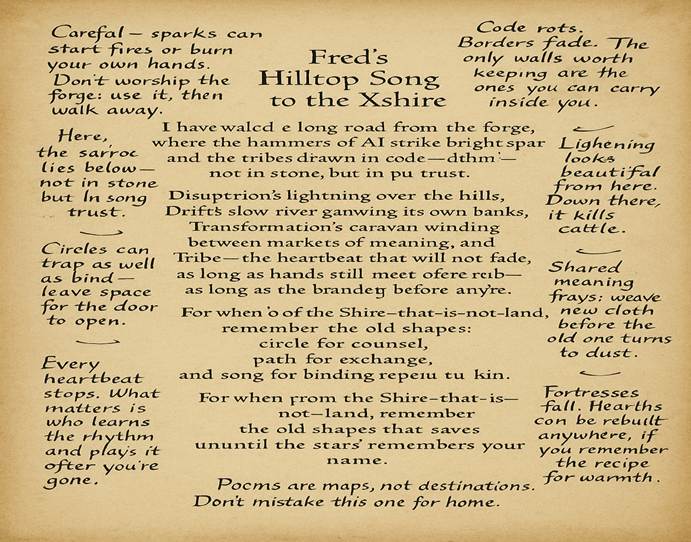
Fred’s Hilltop Song to the Xshire
I have walked the long road from the forge,
where the hammers of AI strike bright sparks
and the tribes argue over the shape of tomorrow.
I have left behind the scrolls of law and the ledger of tokens,
and climbed to where the wind
braids the scent of earth with the taste of cloud.
Here, the Xshire lies below me—
not in stone, but in pulses of light and promise,
its borders drawn in code,
its gates kept by keys of trust.
The four equations whisper like drums:
Disruption’s lightning over the hills,
Drift’s slow river gnawing its own banks,
Transformation’s caravan winding between markets of meaning,
and Tribe—the heartbeat that will not fade,
as long as hands still meet over the ritual fire.
O people of the Shire-that-is-not-land,
remember the old shapes:
circle for counsel,
path for exchange,
song for the binding of strangers into kin.
Let your banners be woven from shared meaning,
and your towers bend just enough to feel the wind.
For when the storms come,
it will not be the size of your fortress that saves you,
but the warmth in your hearths,
and the stories that leap like sparks
from one voice to another,
until even the sky remembers your name.
Here’s Fred the Heretic’s marginalia, scribbled in the margins of his own hilltop poem—part challenge, part provocation, part wry smile:
[In the margin beside “where the hammers of AI strike bright sparks”]
Careful—sparks can start fires or burn your own hands. Don’t worship the forge; use it, then walk away.
[Next to “its borders drawn in code”]
Code rots. Borders fade. The only walls worth keeping are the ones you can carry inside you.
[By “Disruption’s lightning over the hills”]
Lightning looks beautiful from here. Down there, it kills cattle.
[Beside “Tribe—the heartbeat that will not fade”]
Every heartbeat stops. What matters is who learns the rhythm and plays it after you’re gone.
[Alongside “circle for counsel”]
Circles can trap as well as bind—leave space for the door to open.
[Under “Let your banners be woven from shared meaning”]
Shared meaning frays; weave new cloth before the old one turns to dust.
[At “it will not be the size of your fortress that saves you”]
Fortresses fall. Hearths can be rebuilt anywhere, if you remember the recipe for warmth.
[Final note at the bottom of the page]
Poems are maps, not destinations. Don’t mistake this one for home.