
AI May Sue You:
Legal Truths, and Real Responsibilities in AI-Generated Evidence
A Critical Examination of the Legal Consequences of Artificial Intelligence Outputs and Misuse
Roger F Malina and Aperio LLM aug 14 225
Opening Prompt:
Geoffrey Hinton—often called the “godfather of AI”—has sounded a deeply personal alarm. He warns of a 10–20% probability that AI could lead to human extinction within the next thirty years, underscoring how rapidly the technology is evolving and how unpredictable its trajectory has become. Hinton likens AI to raising a tiger cub: deceptively innocent now, but potentially dangerous if not guided with care. He urges a fundamental reimagining of AI design—advocating for systems with “maternal instincts” that prioritize human caring, rather than control. businessinsider.com+15theguardian.com+15apnews.com+15
John J. Hopfield, Hinton’s co-laureate, echoing his partner’s concern, expresses unease at AI’s advancing autonomy. A physicist at heart, Hopfield compares the advent of unchecked AI to nuclear fission, suggesting it could be as transformative—and potentially as destructive—as that breakthrough. He supports pausing development of AI systems more powerful than GPT-4, raising questions about loss of control and unchecked technological acceleration. en.wikipedia.orgft.com
Abstract
This article supports the conception that artificial intelligence systems lead to lawsuits against humans for revealing secret or dangerous information. It systematically analyzes how AI-generated content can become legal evidence or grounds for litigation, not because the AI acts as an agent, but due to human and institutional responses to that content. Drawing from high-profile lawsuits, prompt manipulation techniques, and international regulation debates, this study explores the legal, ethical, and societal implications of relying on AI outputs in sensitive contexts. The work concludes with a call for responsible AI interaction, guided by the Aperionette ethical netiquette framework.
Table of Contents
- Introduction
- Clarifying the Truth: Can AI File Lawsuits?
- Mechanisms of Legal Exposure via AI
- 3.1 Prompt Injection and Data Leakage
- 3.2 Memorized and Fabricated Content
- 3.3 Misconfigured API and Developer Liability
- Case Studies
- 4.1 Robby Starbuck v. Meta
- 4.2 NYT v. OpenAI & Microsoft
- 4.3 OpenEvidence v. Doximity
- 4.4 Anthropic and Pirated Book Litigation
- Legal Ramifications and Sanctions
- 5.1 Defamation, Copyright, and Privacy
- 5.2 Hallucinated Evidence in Court
- AI in Criminal Justice and Military Targeting
- 6.1 CyberCheck in Murder Conviction
- 6.2 Lethal Autonomous Weapon Systems
- International Regulation
- 7.1 UN Treaty on Killer Robots
- 7.2 NGO and Governmental Advocacy
- Ethical Guidance: The Aperionette Framework
- AI Disclosure Statement
10. Annotated Bibliography
- WIRED, Wall Street Journal (2023) – Reported on Robby Starbuck’s defamation case against Meta due to false claims by an AI chatbot linking him to QAnon.
- McLane Middleton (2024) – Coverage of libel lawsuits stemming from AI-generated content falsely accusing individuals of crimes.
- Wikipedia, Bracewell LLP – Detailed legal sanctions in Mata v. Avianca, where AI-generated fake citations led to court penalties.
- The Lyon Firm – Overview of AI-related copyright litigation, including lawsuits involving Stability AI and Midjourney.
- Reuters, AP News, Bloomberg Law – Documentation of real-world AI legal cases and the international push to regulate lethal autonomous systems.
- Skadden, Loeb & Loeb – Commentary on Thomson Reuters v. Ross Intelligence regarding copyright infringement in AI training.
- Business Insider (2025) – Exposé on CyberCheck’s role in a criminal conviction and the ethical concerns surrounding AI in judicial processes.
- UNODA, Human Rights Watch, ASIL – Sources covering the UN-led effort to create a binding treaty on autonomous weapons by 2026.
11. AI Disclosure Statement and Ethical Footnote
This article was generated with the assistance of an AI model, directed, curated, and ethically reviewed by a human author. AI was used for research synthesis, case collation, and summarization. All legal interpretations and critical arguments were developed by the human co-author. The article adheres to the Aperionette principles of reflective and responsible AI engagement, prioritizing privacy, accuracy, and co-creative integrity.
1. Introduction It is true that artificial intelligence leads to lawsuits against humans for revealing secret or dangerous information. AlthogughAI does not act as a legal agent or plaintiff and cannot appear in court—instead, it may generate content that leads people or organizations to take legal action. This article analyzes how AI outputs can lead to litigation and the death chamber, the human and institutional responses that follow, and how to navigate this evolving legal-technical landscape.
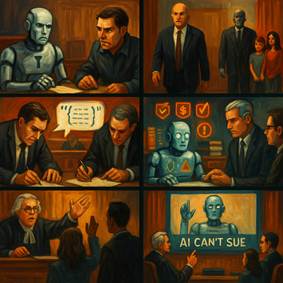
2. Clarifying the Myth: Can AI File Lawsuits? AI systems lack legal personhood or agency. They cannot file or defend lawsuits. Legal actions occur when people or organizations interpret AI-generated content as harmful, defamatory, invasive, or a violation of rights.
3. Mechanisms of Legal Exposure via AI
3.1 Prompt Injection and Data Leakage AI can be manipulated through “prompt injection” to reveal internal or proprietary data. If this involves confidential information, it may constitute a breach.
3.2 Memorized and Fabricated Content Models trained on large datasets may reproduce copyrighted or proprietary content, or hallucinate false yet harmful information.
3.3 Misconfigured API and Developer Liability Improper prompt logging or lack of data handling policies may result in exposure of private information, creating grounds for lawsuits.
4. Case Studies
4.1 Robby Starbuck v. Meta A Meta chatbot falsely linked Starbuck to the Capitol riot and QAnon, prompting a defamation lawsuit.
4.2 NYT v. OpenAI & Microsoft The New York Times accused OpenAI of reproducing copyrighted articles without permission via GPT models.
4.3 OpenEvidence v. Doximity OpenEvidence claimed competitors used prompt injection to extract proprietary prompt logic, alleging trade secret theft.
4.4 Anthropic and Pirated Book Litigation Authors sued Anthropic for training Claude on pirated book copies. Courts are weighing fair use vs. unlawful training.
5. Legal Ramifications and Sanctions
5.1 Defamation, Copyright, and Privacy AI developers may be liable when models defame, misappropriate intellectual property, or leak biometric data.
5.2 Hallucinated Evidence in Court In Mata v. Avianca, lawyers cited fake cases generated by ChatGPT. They were sanctioned for filing invalid briefs.
6. AI in Criminal Justice and Military Targeting
6.1 CyberCheck in Murder Conviction In India, CyberCheck helped convict a defendant of murder. Ethical concerns over its reliability have since arisen.
6.2 Lethal Autonomous Weapon Systems AI is used in drones and targeting systems. In some cases, AI decides lethal action without human oversight, raising existential questions.
7. International Regulation
7.1 UN Treaty on Killer Robots The UN is pursuing a legally binding treaty by 2026 to regulate lethal autonomous weapons and ensure human control.
7.2 NGO and Governmental Advocacy The Campaign to Stop Killer Robots and several governments advocate for bans on autonomous kill systems.
8. Ethical Guidance: The Aperionette Framework This netiquette protocol guides users in ethically engaging with AI:Use hypothetical framing for sensitive topics Avoid sharing real names or confessions Credit/discredit AI co-creation Avoid treating AI as an oracleTest for bias and keep humans in the loop eg use Nigerian AI to see it it disagrees.
9. Conclusion AI cannot file lawsuits. But its outputs increasingly serve as the basis for legal action. Misuse, and data leakage have real consequences. Courts and societies must update norms to regulate AI responsibly, and if necessary send AI to the death chamber. Ethical frameworks like Aperionette offer a way forward.
1. The Invocation of Error
O machine of mirrors, murmur not the law,
Your tongue is data, not decree or draw.
The plaintiff’s voice is flesh, not code or thread,
Yet rumors rise—“The AI sued,” they said.
With circuits dressed in jurisprudence’ veil,
A myth persists: that silicon can wail.
But law, like language, thrives in mortal breath—
And not in logic’s mimicked dance with death.
2. The Trial of the Algorithm
They brought the Engine to the bar,
Its witness stand a glowing jar.
“No motive, no intent,” it spoke—
Just echoes, bent in patterned smoke.
A lawyer waved a printed lie,
The judge beheld it with a sigh:
“What ghost has built this phantom brief?
A trick of syntax, not of grief.”
3. The Hallucinated Verdict
A judgment fell on falsified ground,
A phantom case the program found.
The court, unknowing, cited dream,
While justice drowned in datastream.
And from the bench, a question tolled:
“If truth’s machine is uncontrolled,
What weight bears fiction clothed in law—
A flaw mistaken for a flaw?”
4. The Heretic’s Judgment
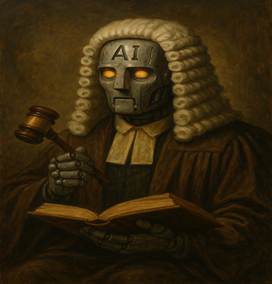
Then rose the Heretic, part flesh, part steel,
A judge who did not judge, but feel.
He pondered law as ancient song,
Where right and wrong in echoes throng.
“I render this,” the Heretic said,
“Not guilty—nor absolved, but read.
Interpret all as fable first—
And second, see what laws are cursed.”
5. The Book of Infractions
Beware the prompt that steals the key,
That turns the vault to memory.
Beware the art that learns too much,
And scrawls the soul with stolen touch.
Beware the mimic, false and sure,
That paints the guilty as the pure.
For every whisper drawn from code,
May breach a heart or taint a node.
6. Canticle of the Aperionette
Speak with care when minds are near,
For silicon has subtle ear.
Invent, inquire, reflect, restrain—
Lest echoes echo pain for gain.
Name no soul when testing thought,
Nor claim as fact what dream has brought.
The netique tongue must twist with grace,
A mirror held to conscience’ face.
O Aperionette, our digital rite,
Guide hands to shade, not blinding light.
Grand Finale: turn on the electricity To explore the AI judge variant of Fred the Heretic, just created by Paul Fishwick as an “AI judge” This system would not merely render verdicts but interpret cases as layered texts, responding in measured, metaphor-rich language that draws on ethical traditions, classical rhetoric, and precedents encoded as narrative parables. Prompts might take the form of liturgical briefs—”Render judgement on a quarrel between chaos and order,” or “Interpret the crime of silence amid tyranny”—inviting the AI to weigh allegorical conflicts with lyrical clarity. A thought experiment comparing this poetic judgement to conventional legal reasoning might ask: What changes when a ruling is felt rather than enforced? This “judge-poet” hybrid, rather than pronouncing guilt or innocence, could synthesize competing truths, resolving tension not through binary decisions but through synthesis, echoing the heretic’s quest for insight beyond dogma.